
Welcome to PYPteachingtools.com
Easy Activities for Developing IB PYP Communication Skills

This article is bringing you some creative ideas for developing the IB PYP communications skills with your students. These are all practical and simple ideas that I've used in my class over the years with much success, much laughter and a lot of meaningful learning too. As I was listening to Claire, from The Art Engager podcast, this quote stuck with me, as I thought about how to better support my learners and reminded me of a really simple activity for mindful listening.
"Becoming more aware of your listening skills is the first step to improving them. "
The Art Engager Podcast
LISTENING MINDFULLY
Listening is often overlooked as a communication skill and so I like to begin here to remind the children that this is really a big part of collaborative discussions. We need to be able to listen to respond to others rather than listening to react.
And so, a simple but effective activity for all ages that can be done indoors or outdoors is to just simply stop and listen. If you th...
Supporting A Collaborative Classroom in the IB PYP

The very nature of the student led, inquiry based classroom is to amplify the children's voice and bring their thinking to light. As part of 21st century skills, we know that collaboration is a key player in this development of learning. There is no doubt that the process of learning through collaboration is the evolution of expanding understanding. It breaks away from that traditional " I" and "me" method of learning and brings forth the community mindset. We want to build up this sense of collective agency through our culture of community learning.
Why Collaborative Learning?
This form of learning enables a multitude of sub-skills and ALL of the IB PYP Approaches to Learning Skills. It brings meaningful experiences to learning and allows our students to work towards a higher level of thinking as they build upon each others' thoughts and ideas.
- Social skills: Becoming active participants of a social setting presents opportunities for the children to become more effective wit ...
Mindfulness in the Classroom – An IB PYP ATL Skill

What is mindfulness exactly? And why would we need mindfulness in the classroom? According to Wikipedia, mindfulness is:
- a mental state achieved by focusing one's awareness on the present moment, while calmly acknowledging and accepting one's feelings, thoughts, and bodily sensations, used as a therapeutic technique.
- the quality of being aware or conscious of something
When I consider those definitions in relation to mindfulness in the IB PYP classroom, the key words that jump out to me are:
being aware, focusing, present, accepting, feelings, thoughts, therapeutic.
Connecting with the Learner Profile
All very similar to being reflective, don't you think? Since we have a whole child approach to teaching, this makes perfect sense that we would help to develop awareness of self as an approach to learning. If we think about how many attributes within the the Learner Profile align with mindfulness, we can then see how, through taking time to explicitly teach mindfulness stra
...Steps & Strategies for Developing Research Skills in the IB PYP


Research. The ability to help ourselves to find an answer to a question or the solution to a problem.
This potential to find answers for ourselves is a skill that includes the ability to decide specifically what we want to know, to find information about a topic, evaluate that information, analyse and interpret the information and then put it all together in a way that brings us answers and solutions for ourselves. This is a skill that we want our students to develop.

Developing research skills includes explicit teaching of the skill, leading to implicit practice. This resource does exactly that with task cards targeting the research sub-skills.[/caption] The research sub- skills that our IB PYP students need, right from the earliest years include:
- Observing
- Formulating questions
- Media literacy
- Sourcing data
- Evaluating sources
- Analysing & interpreting data
- Synthesising
- Reflecting
- Presenting
We want to ensure that the children's research inquiries are structur...
Developing Mindfulness within the IB PYP

To get straight to the point: mindfulness belongs in the classroom. As an IB PYP teacher, I approach teaching through a philosophy that centres on the child and the development of the whole child. This philosophy resonates with my own beliefs for educating our children to become avid questioners with the skills and strategies and confidence to try to find out for themselves. I nurture a sense of wonder and a strong belief in self. With this sense of self, I have to understand how to develop this awareness of self within the children and how I can guide them towards understanding who they are as unique individuals and also as learners. Mindfulness has been added to the updated IB PYP Approaches to Learning Skills. Specifically, you can now find it under the skill of Self-Management. In order to best serve the children, I first needed to understand exactly what this "mindfulness" thing was.
I'm lucky to be a part of our close-knit community of international inquiry teachers on Instag...
Developing Questioning Skills in the IB PYP Inquiry
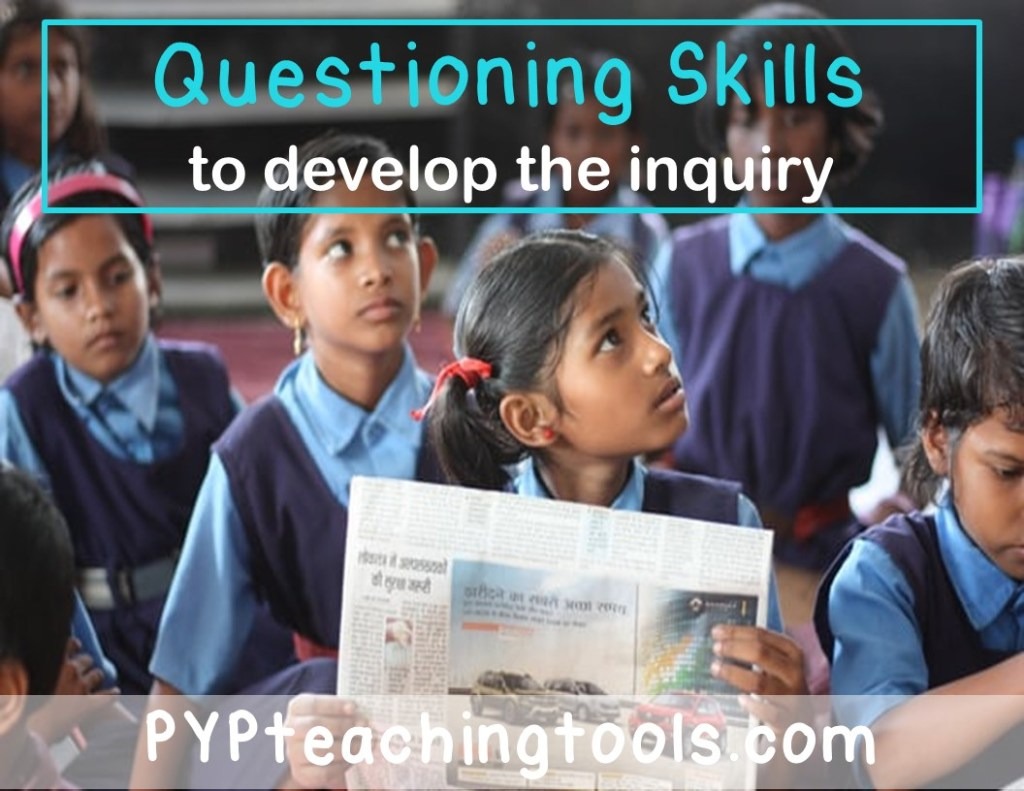
If we are inquiry teachers, facilitating a student-led inquiry process, then it makes absolute sense that we have to be able to teach the children the art of questioning. Questions are, after all, the beginning of each and every inquiry. Questioning plays an important role in building a true student-led inquiry, beginning with the initial provocation. So, where do we start? Well, allow me to share my experience with you and, hopefully, bring you some practical strategies to take back to your own class of inquirers. If you missed the first part of this discussion about developing the Approaches to Learning Thinking Skills, click here to catch up with how I begin to develop those sub-skills. In this article, I have provided a free video that also offers practical suggestions. But, let’s start by doing.
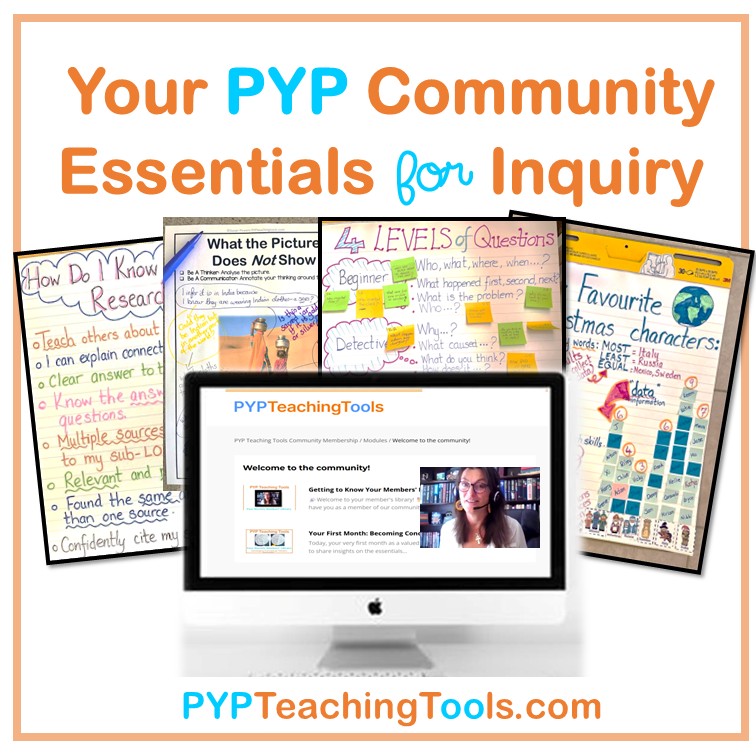
BE INSPIRED. BE CONFIDENT. BE READY! Teaching kids to ask better questions? The membership is full of activities built exactly for that. Explore the Membership🤩
Using simple thinkin...
IB PYP Approaches to Learning Skills

It Takes Skills!
The word is well and truly out. The newest hub bub in the IB world is the Approaches to Learning Skills. Formerly known by the International Baccalaureate Organisation as the Transdisciplinary Skills, these are, simply put, a set of skills that we use when we are involved in learning. They come grouped into five sets: Thinking, Social, Self Management, Research and Communication. They naturally have growth mindset occurring within them, since they cover many different behaviours, self control as well as thinking and communication strategies.

As part of your IB PYP classroom, it is usual to see the skills listed somewhere within the room, as posters ( more posters can be found in my store here and also here) and as part of our daily learning objectives. We often refer to those throughout our week and I also like to list them on my daily Learning Objectives boards, tied in with the subject and goals for that day.

By incorporating the skills (as well as the L...
My Favourite Read Alouds for IB PYP Units

I’ve been reflecting lately on the books I’ve used as read alouds throughout our various units of inquiry, that have both reinforced the inquiry as well as integrated many reading skills and strategies. I’ve compiled a list that may help you also, when planning your units of inquiry and aligning them with the elements of the PYP as well as your reading standards. Over the years, I have taught mainly from 3rd grade ( Primary 3/4) up to 6th grade ( Primary 7) and so you’ll find these books to fit the upper elementary age range more.
There is another blog post relating specifically to books that I love when reinforcing the traits of the Learner Profile. You can link to that post here. But this list is more for read alouds that will tie to many of the essential elements of the PYP, as well as slot in nicely to particular Transdisciplinary Themes.
I have created this list for your convenience. You can click on the picture and the title of each book and it will take you directly to its...
Developing the IB PYP Approaches to Learning Skills with Drama

Drama! It brings out the risk taker in many and inspires Oscar-worthy acting in others. It really is one of my favourite activities in the classroom that incorporates so many skills, which is why I wanted to share some ideas with you regarding using drama with your class. Perfect for any IB PYP theme, especially How We Express Ourselves, it can be incorporated into all subject areas quite seamlessly, not to mention a fabulous way to enhance an Exhibition presentation.

The IB PYP Approaches to Learning Skills are grouped into five areas of skills that we use in our daily journey of learning – Thinking, Communication, Social, Self Management and Research. I have found that when I throw some drama into the mix of my plans, things really start to spice up when it comes to those skills.
How The Skills Link With Drama
If you think about what is required within drama, particularly with some form of script, you’ll find that all of the Approaches to Learning Skills are touched upon to s...
Engaging Learners with Authentic Inquiry

Engagement. You know the scene; the entire class is actively involved in their learning. There’s a quiet buzz going on all around. Children are chatting to each other, conversations are focused discussing ideas, plans, strategies. There is movement around the room, with tools and equipment being independently gathered, heads are together, collaboration is seen all around. You know that you’ve nailed it when the busyness of learning is their business!

But…..and there’s definitely a but, how do we keep this going across the curriculum? Is it too idealistic? Time consuming? Can we cover all standards this way? Can we really trust the kids to run with this? How do we, as the teacher, fit it in?
This post isn’t about what engagement looks like in your classroom but rather about how to initiate and maintain the engagement within authentic inquiry focused learning. Engagement is so much more than just keeping the children busy with activities to complete. Far more than simply looking b...
